




Before You Take the Plunge
Because knowing what you’re getting into is kind of important.
Ever experienced bladder leaks while sneezing, running, jumping, coughing, sneezing or laughing? Blame it on stress urinary incontinence (SUI). It kicks in when our pelvic floor muscles get weak or damaged thanks to childbirth, hormonal fluctuations, or with age.
The Uresta is inserted vaginally, supporting the pelvic floor through the vaginal wall to stop leaks. Best part? You can still pee normally with it in.
If you are new to Uresta, you’ll want to snag the Starter Kit.
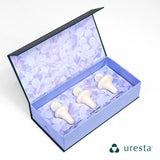
Fun fact: Your Uresta size does NOT depend on your body shape or type! Every woman’s pelvic floor is unique, so we’ve got 5 different size options (2, 3, 4, 5, 6). The Starter Kit includes the three most popular sizes (3, 4, & 5), which works for about 90% of our customers.
If you find you need a either a smaller or a bigger size, no sweat! We’ll ship it to you free within the first 30 days after purchase. Just email support@uresta.com to request one of those additional sizes.
*We also have a private Facebook group. This is a great way to connect with other Uresta women. They are awesome for answering any questions or worries you might have.
Absolutely! Lots of women find the Uresta surprisingly comfy. Once you have the right size and you push it fully into place, you shouldn’t even notice it’s there. It’s comparable to a tampon or menstrual cup in the way it feels… some say even more comfortable!
Uresta tackles stress incontinence head-on! Want to find out if it’s a good fit for you? Take our free assessment here– it’s super quick and easy!
The Uresta is made of a special non-absorbent, hypoallergenic medical-grade thermoplastic elastomer resin. That’s a fancy way of saying it’s safe for long-term use inside the body and doesn’t increase the risk of UTIs, toxic shock syndrome, or other infections. It’s also latex-free and doesn’t contain phthalates like DEHP.
And guess what? Every single Uresta device is proudly manufactured at a leading medical facility in Canada. We believe in giving you the best – because you deserve it!
Uresta is not currently covered by insurance companies in the US, but is FSA / HSA eligible. You can now pay using your FSA / HSA credit card at checkout! Contact your provider to confirm details.
In Canada, Uresta is covered by most major insurance providers, but we always recommend that women give their provider a call to confirm the specifics of their plan.
If the Uresta Starter Kit isn’t right for you – no worries! You’ve got a 30-day window from the day of delivery to get a refund (just hold on to all of your devices).
Heads up: Replacement sizes are final sale.
The Uresta is a self-managed solution! No need to see a doctor to size/fit. The Uresta Starter Kit comes with multiple sizes, so you can find what’s best for you.
Uresta is designed with a handle to make removal easy. Simply grab the handle, twist and pull. For more information, check out our Tips and Tricks!
If you experience challenges with flexibility, physical mobility or dexterity, self-managed devices like Uresta may not be right for you.
Nope! While many pelvic floor physiotherapists and healthcare providers recommend us, you don't require a prescription to purchase Uresta. You can grab Uresta straight from our website here.
We don’t recommend using the Uresta while pregnant. There’s been a lack of clinical research around the use of pessaries during pregnancy, so we say to play it safe and avoid it for now.
Uresta is currently indicated for stress urinary incontinence (aka bladder leaks), and can work well for women with mild prolapse. For more advanced prolapse or prolapse specific symptoms, you may want to discuss with your healthcare provider for more information.
Yes! Once inserted, Uresta sits mid-vagina and below the cervix area, making it unaffected by previous hysterectomy.
You can totally use the Uresta while using estrogen or hormone creams to help with vaginal dryness or atrophy!
We recommend waiting at least ~6 hours after application of the cream to allow it to be properly absorbed by your tissues. We also recommend using our Water-Based Lubricant to help with inserting your Uresta.
Regular pessaries can be a bit of a hassle, right? Needing a prescription, dealing with long wait times, being awkwardly fitted by a doctor, and still feeling uncomfortable inside.
Enter the Uresta, the superhero of stress urinary incontinence (SUI). This is a simple, over-the-counter device you can manage yourself. With a handle, it’s a breeze to insert and remove. Plus, it’s flexible – our Starter Kit includes three of the most common sizes so you can find the right one and fit it yourself without a doctor’s visit. If you need one of our additional sizes, we will send it to you for free!
No wonder 90% of women stick with Uresta after 1 year (beating out 16% for the traditional pessaries!).
The Uresta goes hand in hand with pelvic floor physio – many pelvic floor physios give us a big thumbs up! It provides immediate relief from leaks, which is super handy since it can take some time to see results from pelvic floor exercises. For some gals, those exercises alone aren’t quite enough to stop the leaks, especially during workouts. Sometimes you need a little extra backup, and that’s where the Uresta comes in!
The female pelvic floor is complex, but the process of finding the right size is pretty simple. Start off with the middle size 4 from the Starter Kit and follow these steps:
You’ve hit the jackpot if:
Try a smaller size if:
Try a larger size if:
Some women find their perfect match right off the bat, while others prefer to test out different sizes in different situations (work, the gym, playing with kids, etc.). Take your time to find what works best for you – it’s totally worth it!
A little tip: Joining our private Facebook group is super helpful for chatting with other Uresta users. They are great for answering any questions you might have!
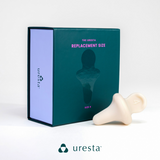
If you end up needing either the smaller size 2 or larger size 6, just email support@uresta.com. We’ll send them your way free if requested within the first 30 days of getting your Uresta Starter Kit.
Uresta inserts into the vagina. Start by taking a few deep breaths to relax. Push out (like you would a bowel movement) as you push in the device. Use a smidge of water-based lubricant if needed.
Once inserted, the Uresta should be fully into the vagina, including the handle. The tip of the handle should be about 2 cm (or ¾ inch) from the opening of the vagina.
No, but some women find they use two sizes depending on what they’re up to and what they’re feeling. Like, they might stick with one size during the day at work but switch it up to a bigger size when hitting the gym. It’s like wearing your sports bra vs. your normal bra.
Also some women find their leaks are worse just before their period, so they use a larger size during that time of the month!
Uresta is inserted vaginally and provides support to your bladder and urethra through the vaginal wall to stop leaks from occurring. Think of it as a sports bra… but for your bladder! It just holds everything in place when you sneeze, jump, cough, etc.!
Nope! The Uresta goes in your vagina and does not block the urethra. The urine stays in your bladder until you’re ready to go to the washroom. The Uresta won’t stop the flow or absorb any of the urine.
If your Uresta fits and is inserted properly, you should still be able to go to the washroom (#1 and #2) as normal. If you’re having trouble going to the washroom, you likely need a smaller size.
When perfectly placed, the Uresta comfortably sits in the middle of your vagina with the tip of the handle located about 2cm (or ¾ of an inch) inside the opening. As time goes on, it might shift slightly higher, but don’t fret – you won’t lose it! The key is that it stays comfortable and within your reach.
PS. If you can still feel it, you either need to push it a bit farther or try a smaller size.
For some extra pointers, we recommend checking out our Tips & Tricks page. There’s also a private Facebook group to chat with other women using Uresta to help answer any questions you have – if that interests you!
No, Uresta will not disappear inside you! It’s totally normal for it to move up in your vagina throughout the day. The handle might be a bit tricky to grab hold of at first, but if you bear down like you’re going to the bathroom, it’ll help relax your pelvic muscles and bring the Uresta closer to the opening.
When it’s time to remove it, just take a deep breath and stay relaxed! The less tense you are, the easier it is to remove.
Uresta is made of a special medical-grade material that doesn’t soak up bacteria or pose the same toxic shock risks as tampons.
For more tips and to connect with other Uresta users, check out our tips & tricks page and join our private Facebook group. We’re here to help with any questions or concerns you might have along the way!
Absolutely, we recommend checking out our detailed Tips & Tricks page!
We also highly recommend joining our private Facebook group to chat with other women using Uresta to help answer any questions you have.
First-timers might run into a small amount of tissue irritation during fitting or the initial use. No sweat, it happens! Take a breather for a few days to let things settle before giving it another go.
Pro tip: Help it along with a dab of water-based lubricant.
Now, if vaginal dryness is giving you a tough time, it’s worth chatting with your doc. They can throw some options on the table, like estrogen creams or hyaluronic acid-based vaginal moisturizers.
It’s very possible that after a few weeks of using Uresta your size may change. This could go either way – some find they need a larger size and some find they need a smaller size. Some women may find they need a larger size shortly after first trying Uresta as their pelvic muscles relax once their body adapts to it. On the flip side, some women may find they will need a smaller size if they have been actively strengthening their pelvic muscles. Over the long-term, it is also likely that the size Uresta you need will change. This could be driven by hormonal fluctuations, changes in strength, different stages of life, or a change in activity levels. For more info on why your size can change, read our blog here.
We do not recommend attaching string or dental floss to the handle of your device, as it can potentially cause damage to the device over time.
We do not recommend the use of coconut oil, or any oil-based lubricants for use with Uresta, as they can damage the device over time.
If you are looking for a recommendation, check out our Water-Based Lubricant formulated with clean ingredients intended to mimic your body's natural lubrication.
We recommend 1 year. Think of it like a wardrobe refresh. For safety and optimal long-term use, we recommend swapping out your Uresta at least once a year. It’s a hygiene thing, like renewing your toothbrush or switching out your socks. Keep it fresh, keep it comfy!
We know a year can fly by when you’re leak-free. That’s why we recommend signing up here to be reminded when it’s time to replace your Uresta.
Just wet the Uresta with warm water and use a dab of any unscented hand soap or use our Natural Cleaning Gel. Then, lather it up and rinse with warm water. We do not recommend boiling your Uresta to sanitize it or using any harsh materials to clean it (such as cleaning products, vinegar, etc.).
Remember to always wash your Uresta before and after every use and use clean hands when inserting and removing.
The Uresta works around your needs. Use it for all day protection, during specific scenarios like a good gym workout, or when you have a bad cold. When wearing it daily, we encourage taking it out before bed and giving your vaginal tissues an overnight break.
Since the Uresta is crafted from a non-absorbent medical-grade material, it does not pose the same risk of toxic shock syndrome as tampons.
The Uresta is licensed by Health Canada and cleared by the FDA, and it’s been shown in clinical studies to be a safe and reliable way to manage bladder leaks. Uresta won’t increase your chances of getting a UTI or other infections!
Plus, it’s made of a special material that does not soak up bacteria, so it doesn’t carry the same risk of toxic shock as tampons.
No, it won’t!
While Uresta isn’t designed for pelvic muscle training, it’s highly effective at managing bladder leaks. In other words, Uresta doesn’t strengthen your muscles, but it also won’t make your incontinence worse.
Yes, Uresta is completely safe to wear through airport scanners. One thing to keep in mind is that similar to menstrual cups, traditional pessaries and other medical devices, it is possible that some of the more sensitive full body scanner types will pick up your Uresta. Airport security staff are usually trained to recognize and ignore women’s health products and ensure the traveller is offered privacy and discretion. If you want to be extra sure, you can always print off this letter that you can hand the security staff if needed explaining the nature of your Uresta.
Safe travels! 🙂
Since the Uresta fits cozily in your vagina, it’s best to remove it before diving into sexy time – could get crowded in there!
We don’t recommend it! Practically-speaking, the Uresta will block menstrual fluids from exiting your vagina, which will be quite messy during removal.
We also cannot recommend that the Uresta be used during menstruation. As a regulated medical product, it must undergo clinical studies to ensure effective and safe use before recommendations are made. While the Uresta has been clinically evaluated in a number of independent studies as safe and effective, none have evaluated the use of the Uresta during menstruation.
Yes you can! Some ladies deal with leaks more often at night, especially when they’re tossing and turning or making multiple trips to the washroom. The Uresta can step in to stop those nighttime leaks. We do suggest that you take out the Uresta during the day for a few hours so your tissues can take a breather. It’s all about keeping things safe and effective for the long haul.
Yes! You can go swimming while wearing your Uresta. Just remember to remove and clean it once you are finished.
Find our Natural Cleaning Gel here.